MM-TRELLIS: Point-Cloud Guided Multi-Modal 3D Vehicle Generation in Autonomous Driving

Hongli Xiao\(^{1,2,3*}\), Youjian Zhang\(^{3*}\), Yucai Bai\(^{3}\), Chaoyue Wang\(^{5}\), Yaohui Jin\(^{1}\), Xiaoguang Ren\(^{2}\), Wenjing Yang\(^{4}\), Long Lan\(^{4\dagger}\)

1MoE Key Lab of Artificial Intelligence, AI Institute, Shanghai Jiao Tong University;
2Academy of Military Science; 3Bosch Innovation Software Development (Wuxi) Co., Ltd.; 4College of Computer Science and Technology, National University of Defense Technology;
5The University of Sydney

\(^{*}\)Equal Contribution \(^{\dagger}\)Corresponding Author


TL;DR: MM-TRELLIS generates high-fidelity 3D vehicle meshes from multi-view images and LiDAR guidance in autonomous driving scenes.

Abstract: Recovering realistic 3D vehicle models from autonomous driving scenes is crucial for synthesizing training data and building simulation environment. However, most existing vehicle generation methods fail to fully exploit multimodal sensors (i.e. multi-view images and LiDAR point clouds) and rely on neural rendering based reconstruction, leading to low-quality mesh. Recently, native 3D generative models have made significant progress, yet they are not built for arbitrary multi-view inputs and often struggle with in-the-wild driving images. In this work, we present MM-TRELLIS, a multi-modal version of TRELLIS for in-the-wild 3D vehicle generation that integrates LiDAR and image sensors from autonomous driving datasets into native 3D generative models. Specifically, multi-view images are cycled as conditioning inputs, while LiDAR point clouds provide test-time guidance to ensure geometric accuracy and cross-view consistency. During denoising, we first align the guidance point cloud with the model priors, then enforce consistency between the generated geometry and the guidance point cloud. Finally, we introduce a voxel filtering strategy based on the opacity of 3D Gaussian Splatting to suppress floaters and produce clean meshes. Comprehensive experiments on Waymo dataset demonstrate our method outperforms existing methods in high-fidelity 3D vehicle generation.
Methodology

Methodology Illustration

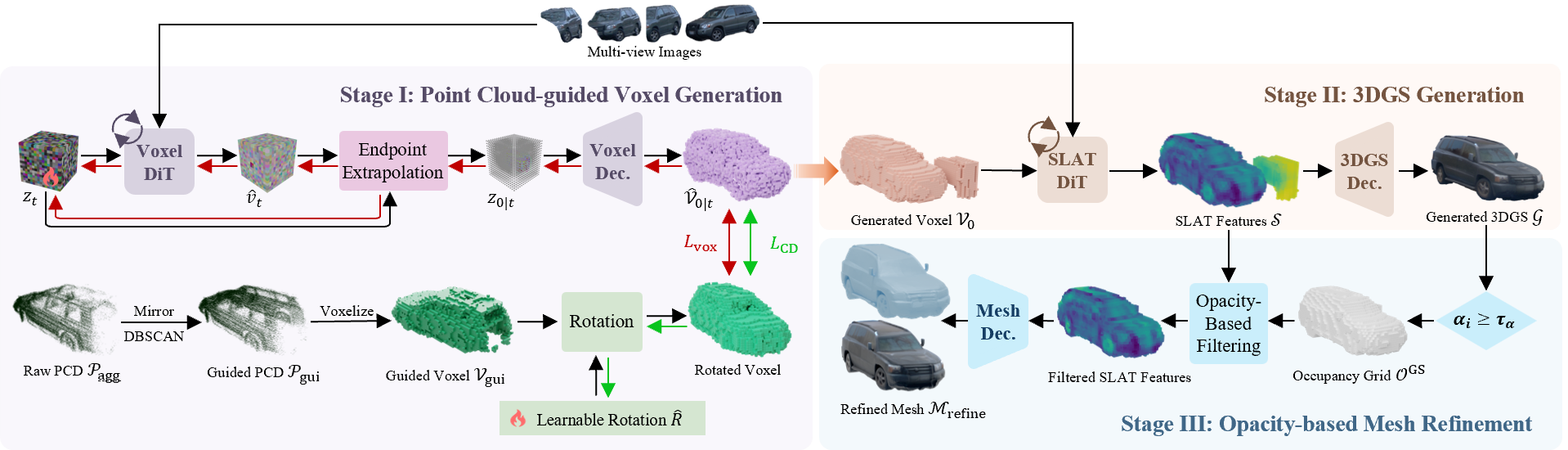
Overview: In stage I, we generate voxels with multi-view cycle conditioning and point cloud guidance. The LiDAR point cloud is first preprocessed and rotated by a learnable parameter $\hat{R}$ to a aligned orientation. Then the voxel guidance is applied to optimize the sampled latent during the denoising process. Stage II perform a 3DGS generation with multi-view conditioning, ensuring the texture fidelity of the generation. Finally, opacity-based mesh refinement is performed in Stage III: a voxel mask is obtained by thresholding Gaussian opacity and filtering SLAT features, and decoding the filtered features produces the final clean mesh.

Results

nvs_compare

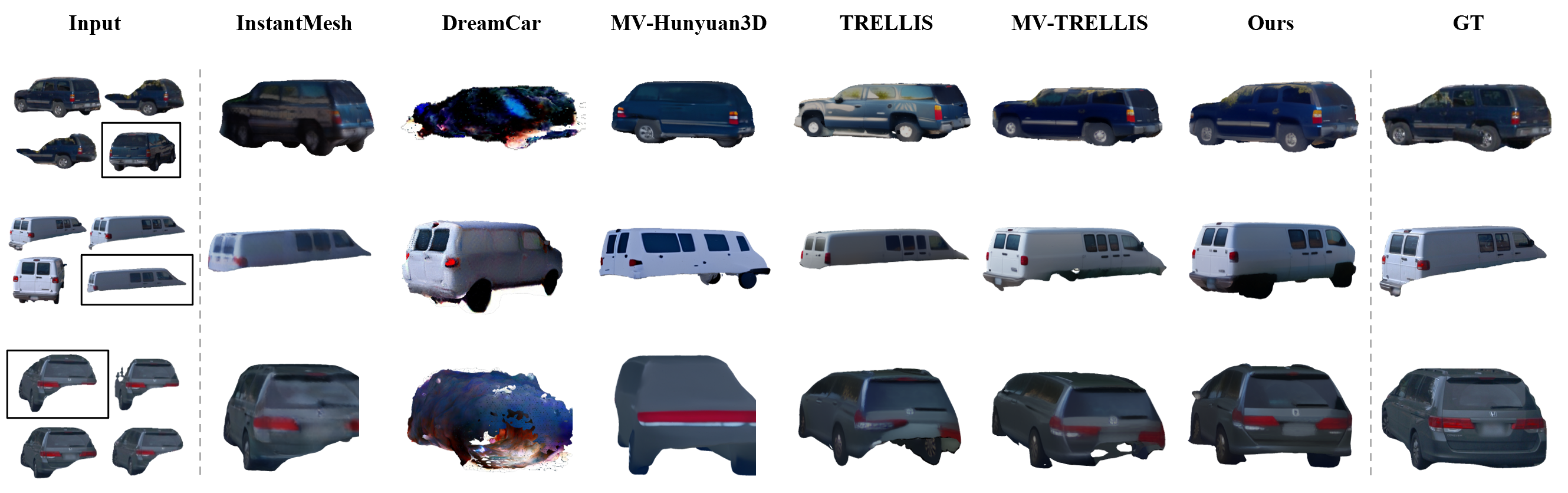
Qualitative comparison with baseline methods in novel view synthesis. The four images in Input column represent the multi-view inputs for multi-view methods, while the image in the black box is used for the single-view method.


nvs_compare

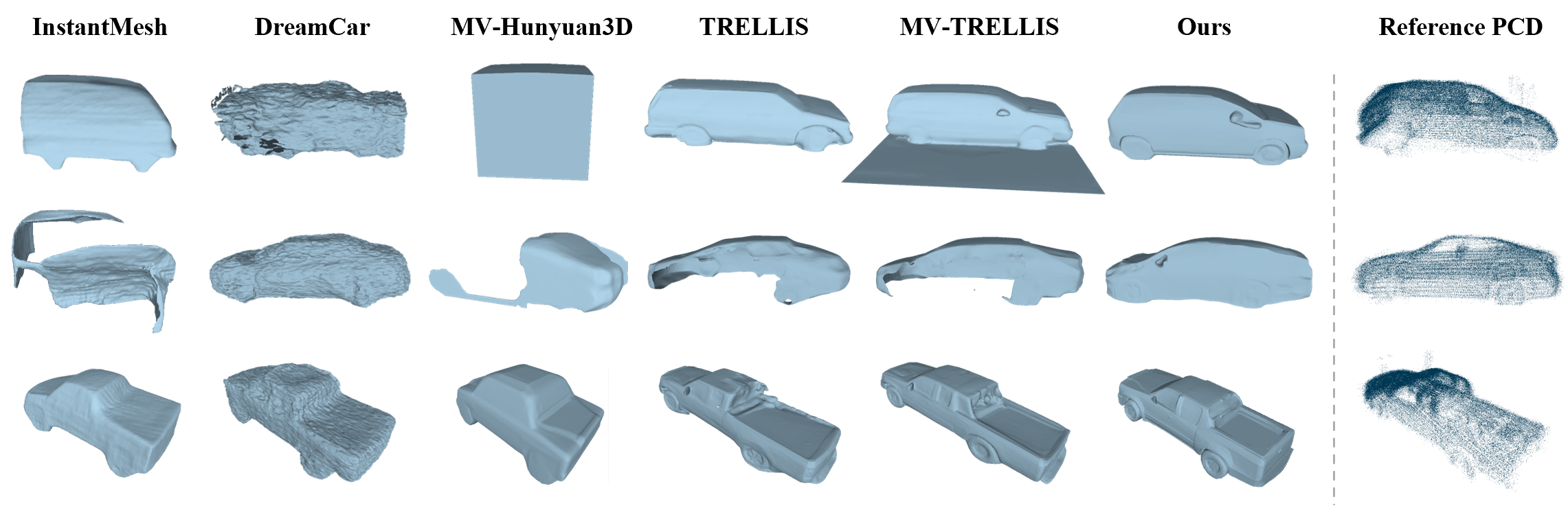
Qualitative comparison with baseline methods in 3D geometry. Rightmost column shows the reference LiDAR point cloud.


Qualitative comparison with baseline methods. MM-TRELLIS generates more accurate vehicle shapes and cleaner meshes by combining multi-view cycle-conditioning with LiDAR-guided optimization.

Extension

Extension to image-only settings. MM-TRELLIS can generate accurate geometry using point clouds estimated from multi-view images via VGGT, without the need for a LiDAR sensor.

Related Links

Check these related work, which provide thought-provoking ideas towards this direction:
  • TRELLIS. A native 3D generative model built on a unified Structured Latent representation and Rectified Flow Transformers, enabling versatile and high-quality 3D asset creation.
  • Marigold-DC. A plug-and-play depth completion method built on a diffusion-based monocular depth foundation model with test-time sparse-depth guidance, enabling strong zero-shot generalization across domains.