HiFiVe: High-Fidelity Vehicle Generation Leveraging Auto-Regressive 2D Generative Priors

Hongli Xiao\(^{1,2,3*}\), Youjian Zhang\(^{4*}\), Qi Zheng\(^{5}\), Zhaohui Hu\(^{3}\), Yaohui Jin\(^{1}\), Xiaoguang Ren\(^{2}\), Wenjing Yang\(^{3}\), Long Lan\(^{3\dagger}\)

1MoE Key Lab of Artificial Intelligence, AI Institute, Shanghai Jiao Tong University;
2Academy of Military Science; 3College of Computer Science and Technology, National University of Defense Technology;
4Bosch Innovation Software Development (Wuxi) Co., Ltd.;
5Shenzhen University

\(^{*}\)Equal Contribution \(^{\dagger}\)Corresponding Author
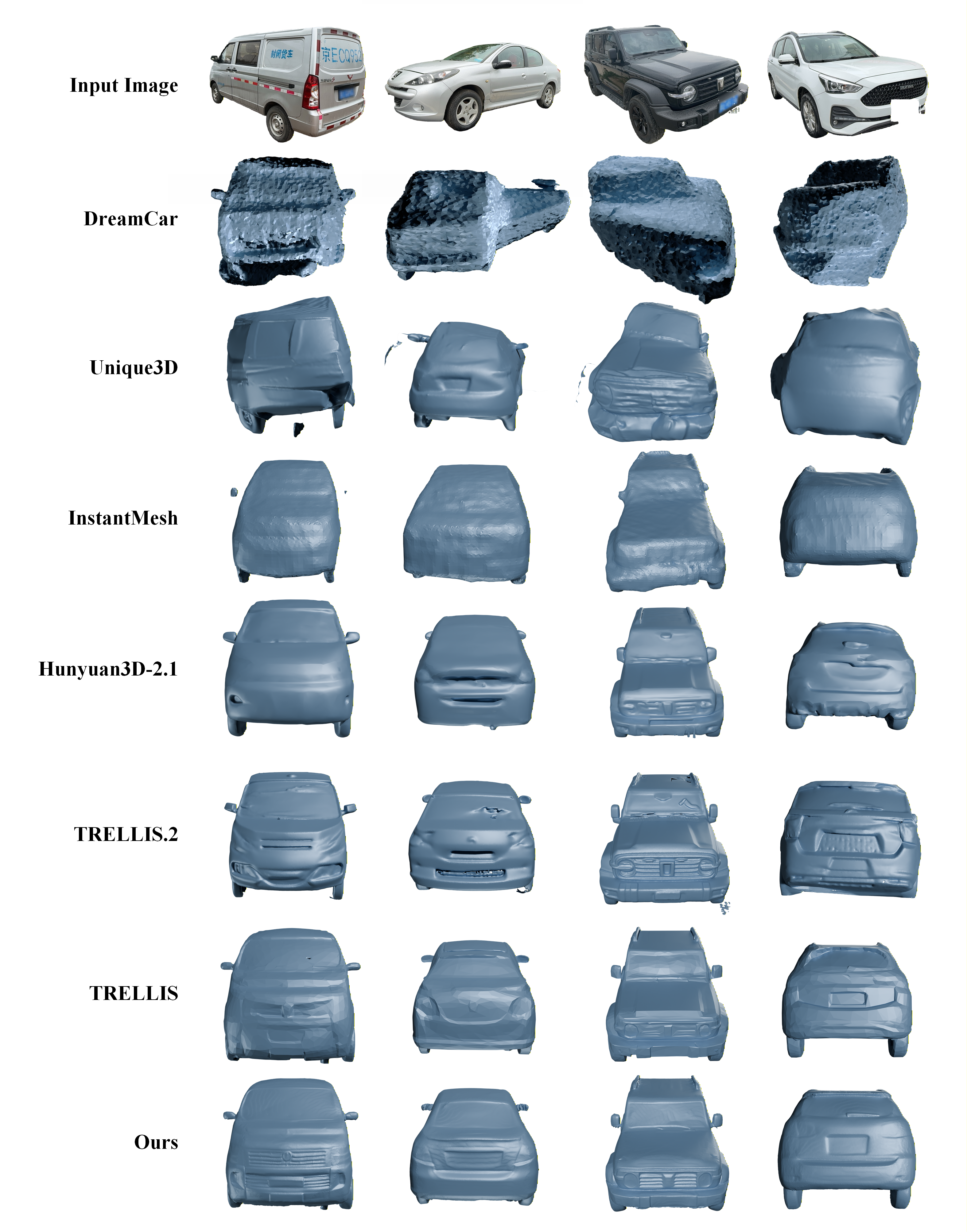
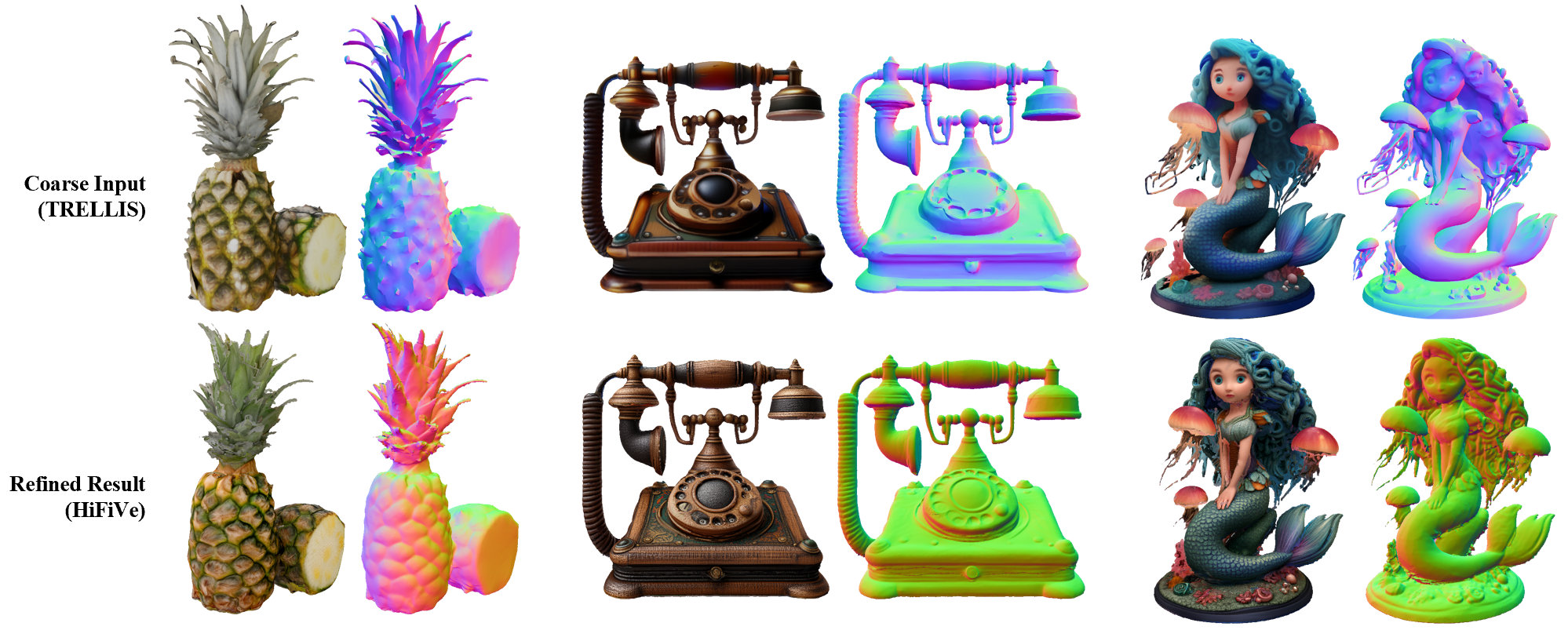
HiFiVe teaser: comparison with TRELLIS

TL;DR: HiFiVe upgrades coarse 3D vehicle meshes into high-fidelity assets by synchronizing auto-regressive 2D generative priors with explicit 3D geometry.

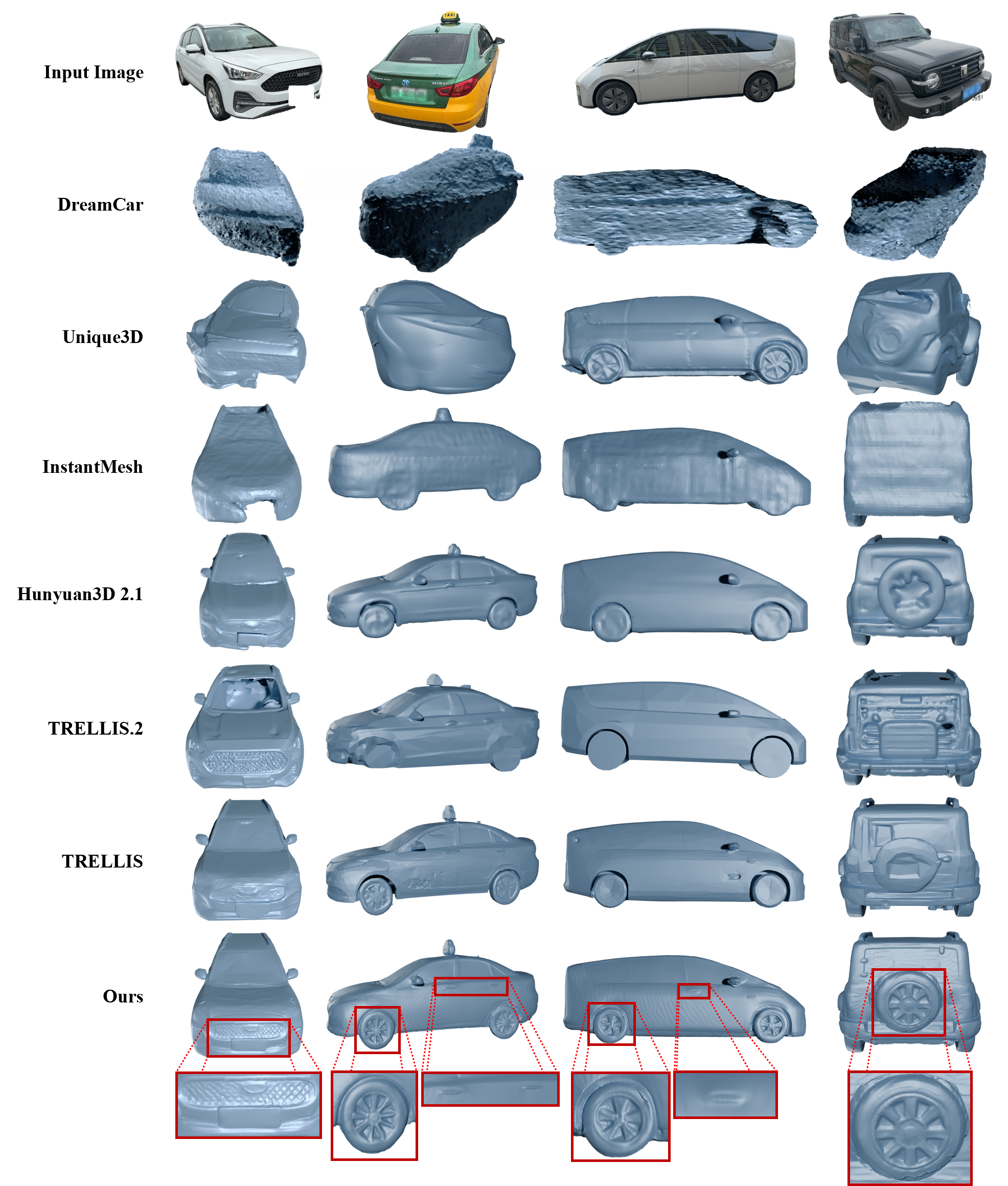
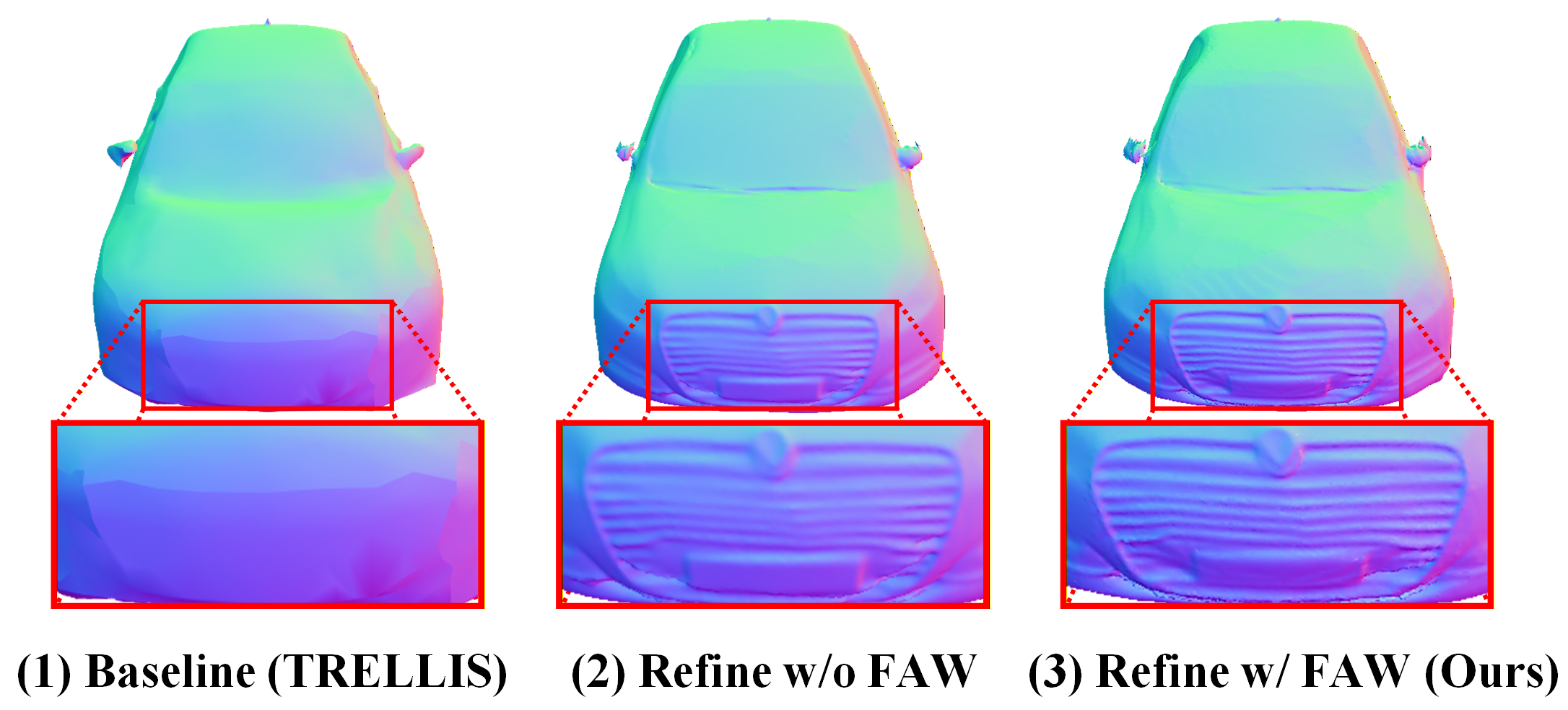
Abstract: Existing 3D vehicle generation methods often suffer from low geometric fidelity and blurry textures, hindering their downstream applications. While recent works adopt multi-view diffusion models for high-fidelity texture, they are often constrained by fixed viewpoints, limited resolution, and a reliance on costly fine-tuning to achieve cross-view consistency. In this paper, we propose HiFiVe, a training-free framework for high-fidelity vehicle modeling through joint texture and geometry enhancement by imposing 3D geometric constraints to anchor 2D generative priors. Specifically, we propose an auto-regressive texture refinement pipeline that progressively synthesizes high-resolution textures from arbitrary viewpoints. To ensure cross-view consistency, the coarse geometry serves as a synchronization prior, conditioning each generation step on previously synthesized frames via depth-based warping and multi-view texture fusion. Moreover, the inherent symmetry of vehicles is exploited to mitigate error accumulation. Finally, high-frequency surface details are recovered by refining the mesh geometry using normal maps estimated from the enhanced textures. Extensive experiments on synthetic and real-world vehicle datasets demonstrate that our method significantly improves both geometric detail and texture quality compared to state-of-the-art baselines.
Methodology

Methodology Illustration

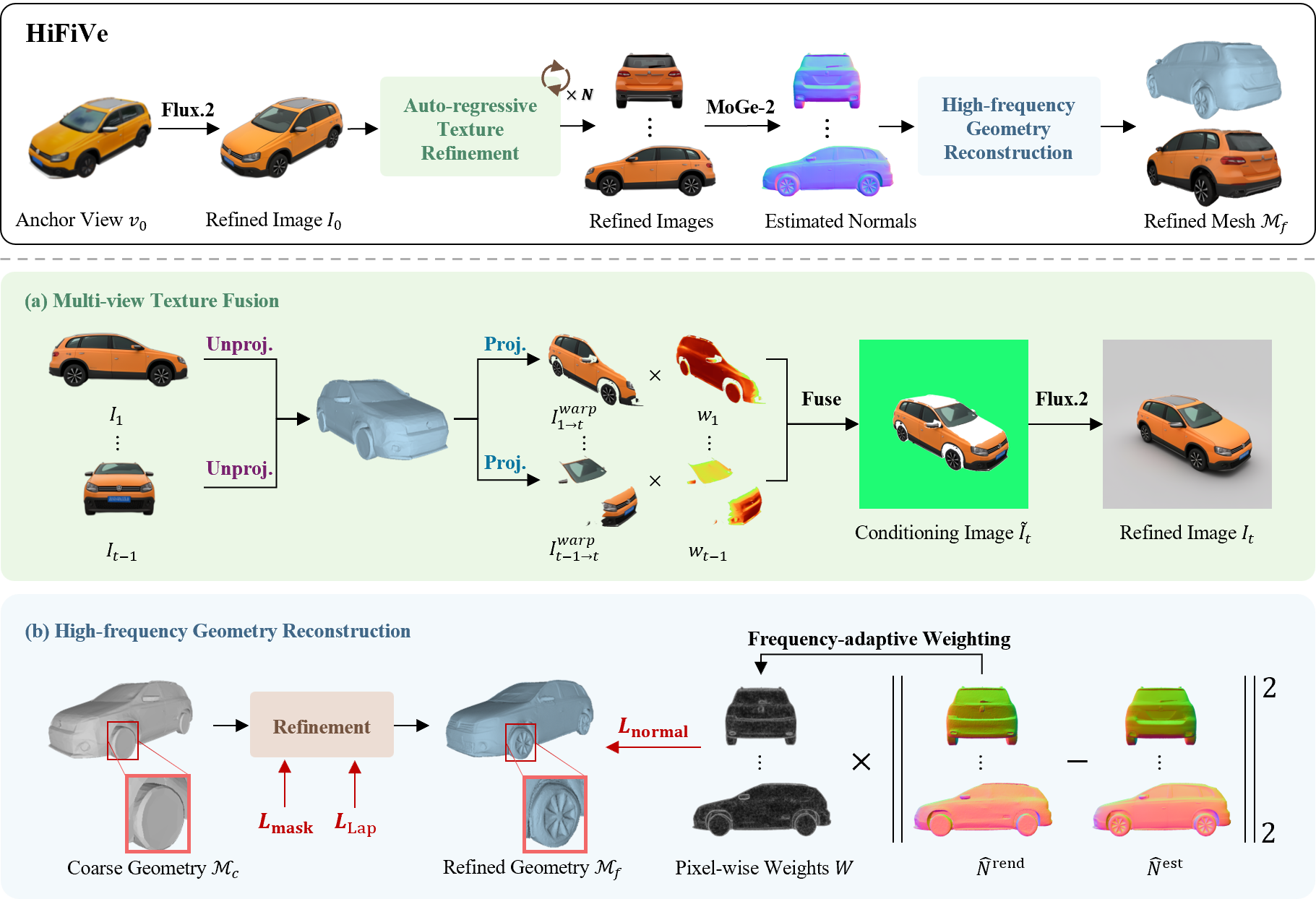
Pipeline: Starting from a coarse vehicle mesh, the framework generates multi-view texture images via geometry-synchronized autoregressive refinement with confidence-aware fusion. Then normal maps estimated from the refined textures guide high-frequency geometry refinement with frequency-adaptive weighting, resulting in a high-quality 3D vehicle model.

Vehicle-specific generation trajectory
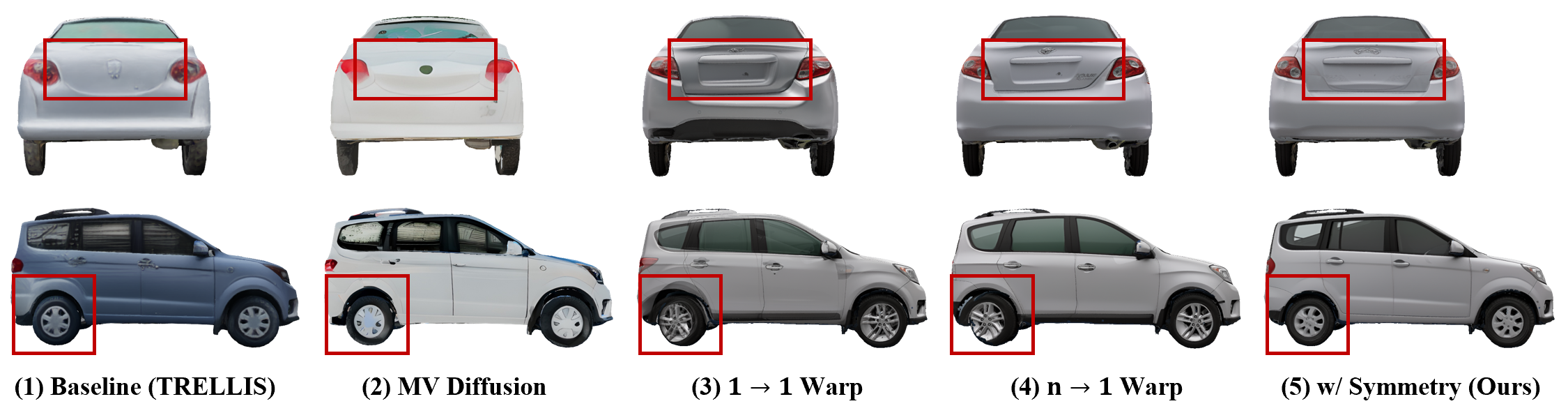
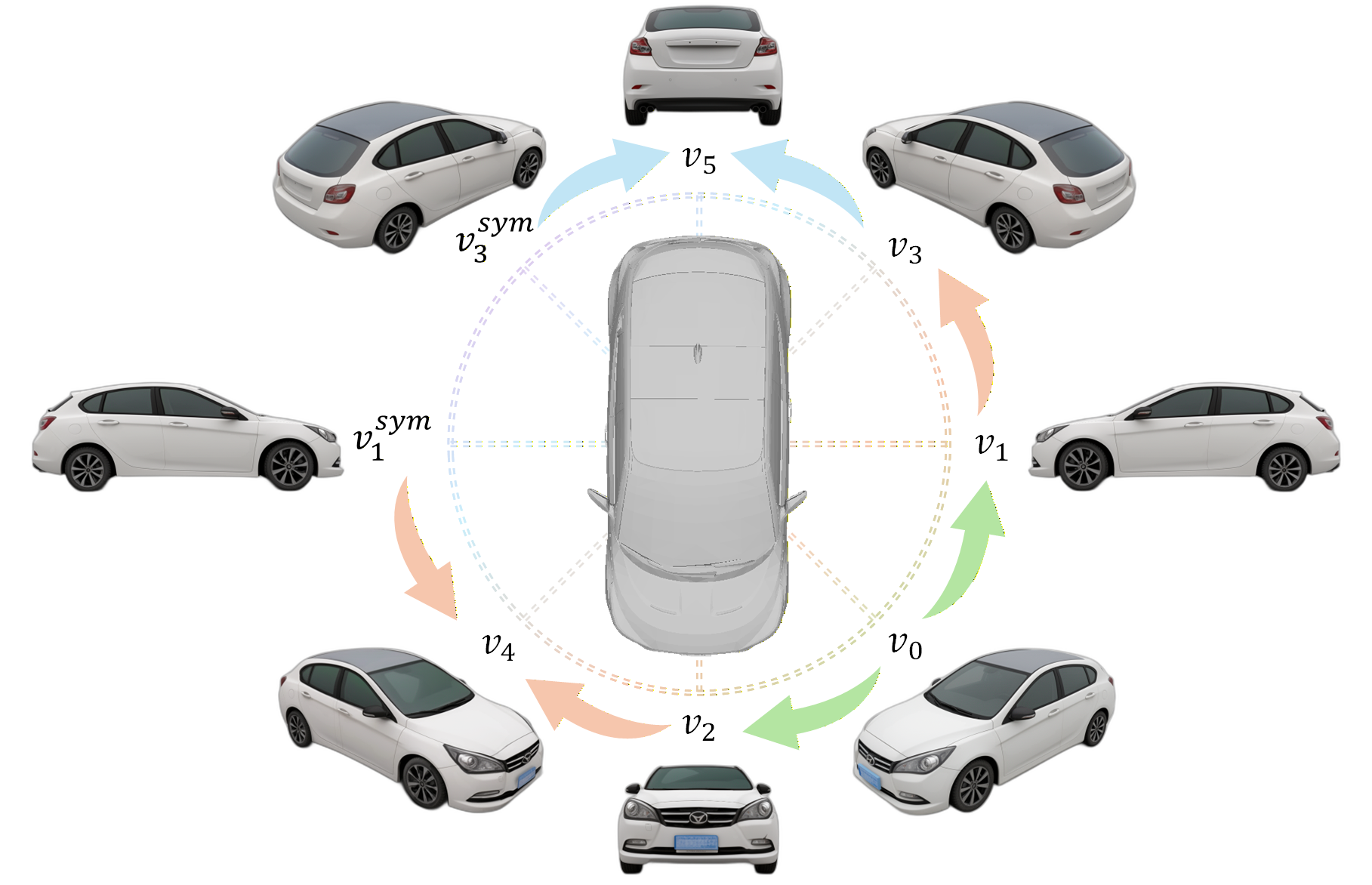
Vehicle-specific symmetric trajectory used to shorten the auto-regressive chain and reduce error accumulation.
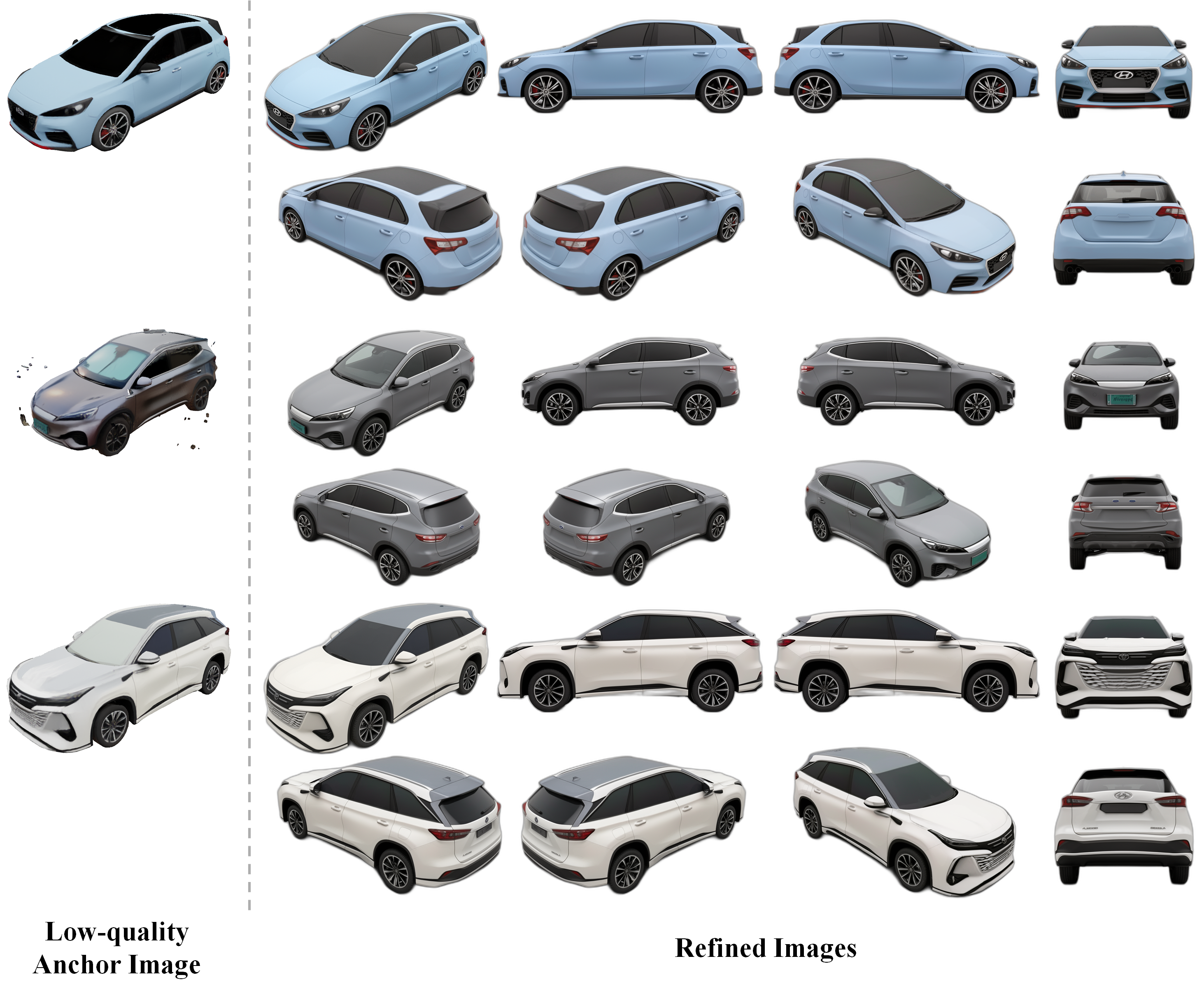
Trajectory results
Qualitative effect of the generation trajectory on multi-view texture consistency.

Results

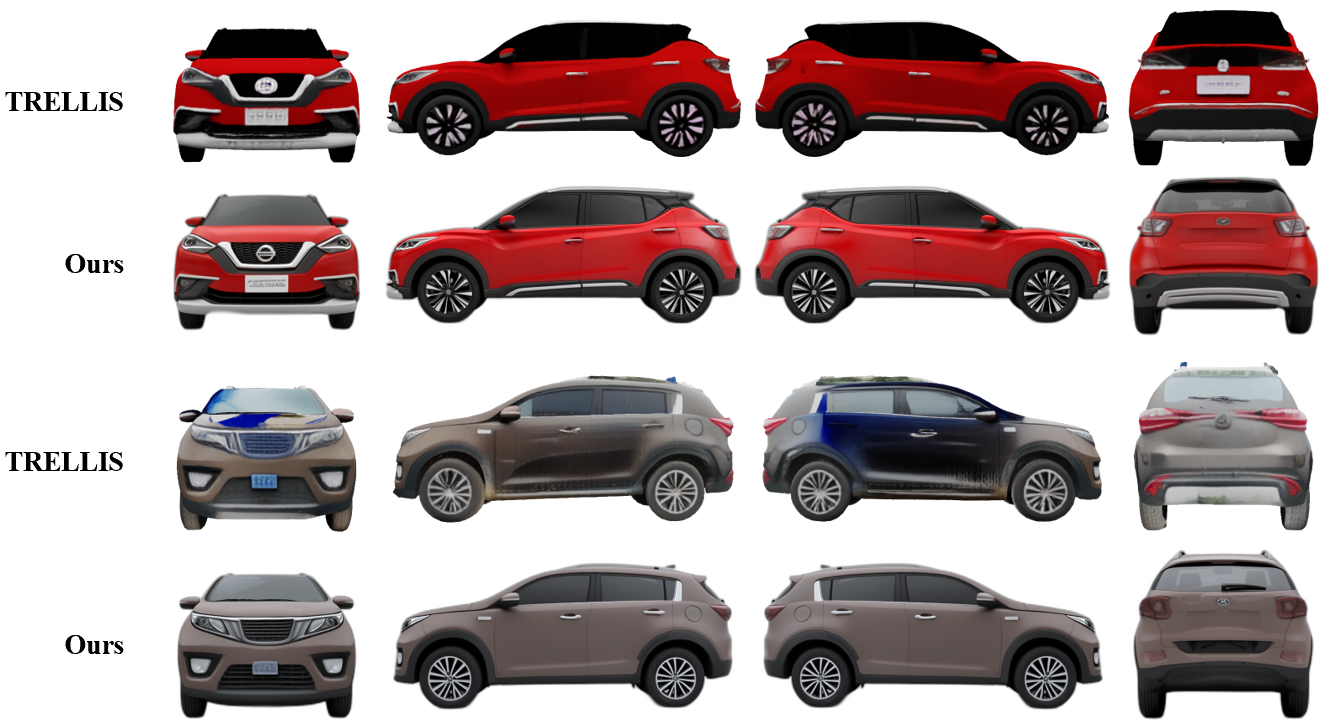
mv_comp_with_TRELLIS

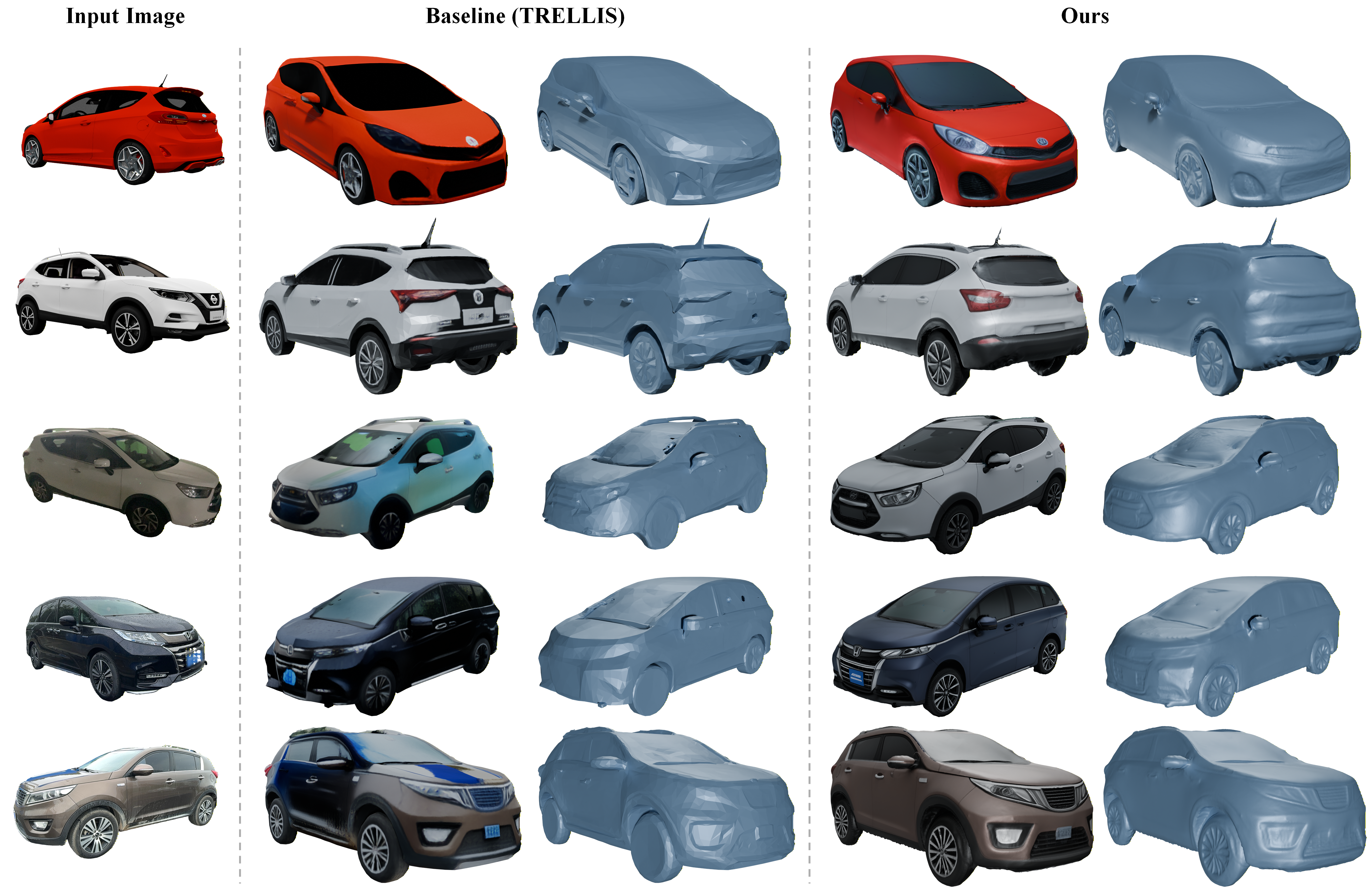
The comparison of texture refinement results with the original textures from TRELLIS coarse mesh.

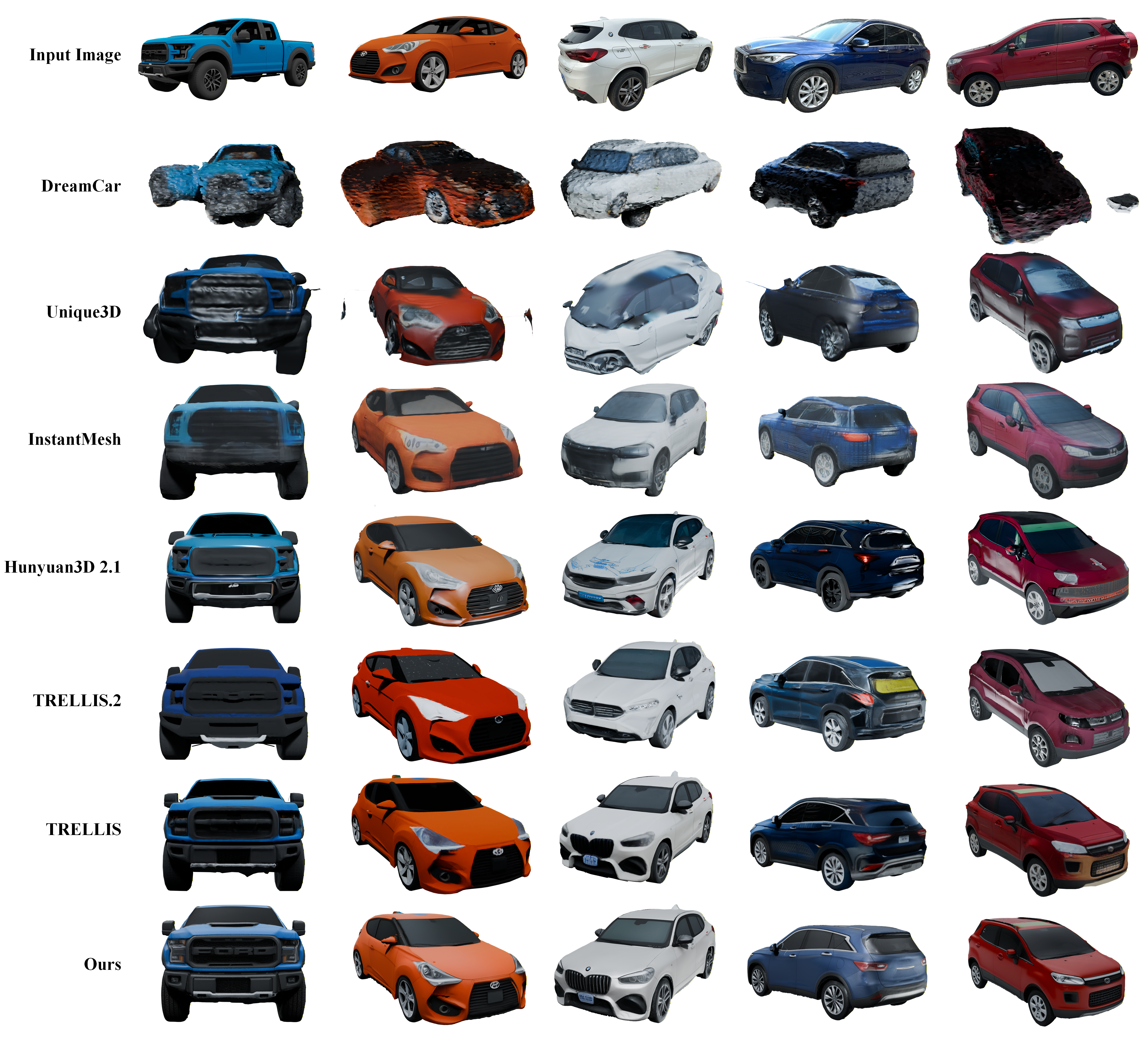
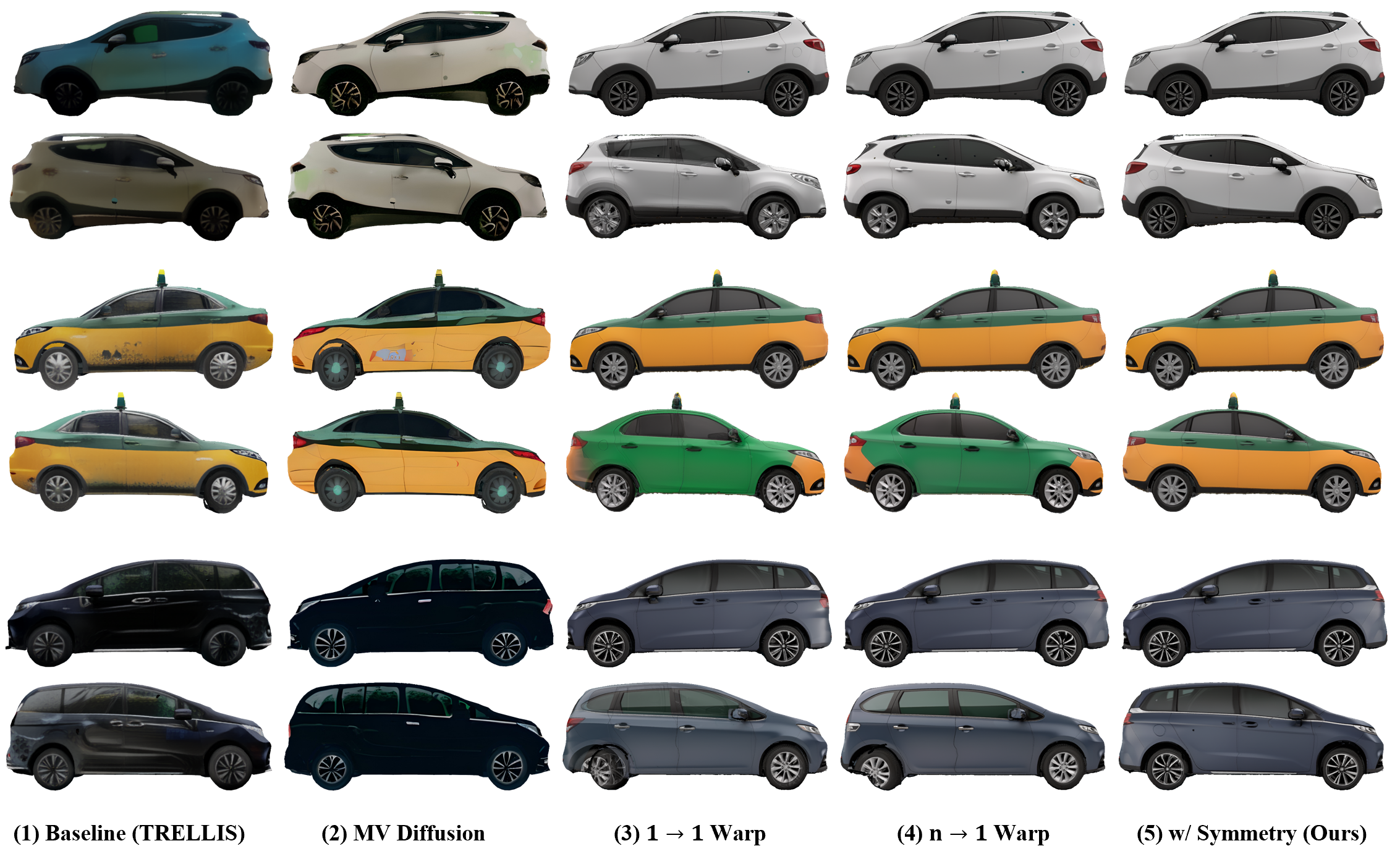
Texture comparison

Qualitative comparison with baseline methods in texture quality on the SketchFab-Cars and 3DRealCar datasets.

Ablation

Extension

Extension to other categories

Proof-of-concept extension to non-vehicle categories. Without the vehicle-specific symmetric shortcut, HiFiVe can still leverage category-specific prompts and 3D constraints for high-fidelity refinement.

BibTeX

@misc{xiao2026hifive,
  title         = {HiFiVe: High-Fidelity Vehicle Generation Leveraging Auto-Regressive 2D Generative Priors},
  author        = {Xiao, Hongli and Zhang, Youjian and Zheng, Qi and Hu, Zhaohui and Jin, Yaohui and Ren, Xiaoguang and Yang, Wenjing and Lan, Long},
  year          = {2026},
  eprint        = {2606.25300},
  archivePrefix = {arXiv},
  primaryClass  = {cs.CV},
  doi           = {10.48550/arXiv.2606.25300},
  url           = {https://arxiv.org/abs/2606.25300}
}