3DCarGen: Scalable 3D Car Generation via 3D-consistent Multi-view Synthesis


1MoE Key Lab of Artificial Intelligence, AI Institute, Shanghai Jiao Tong University, China
2Academy of Military Science, China
3The University of Sydney, Australia
4College of Computer Science and Technology, National University of Defense Technology, China

*Equal Contribution Corresponding Author
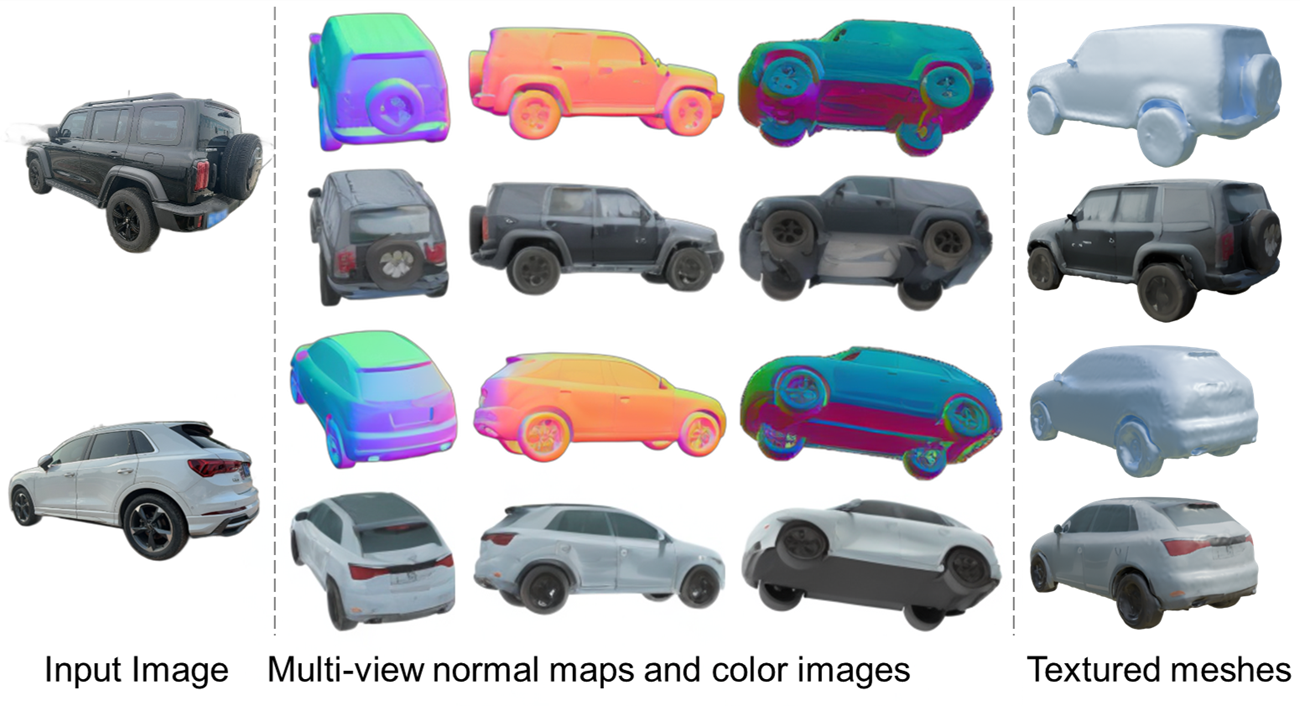
3DCarGen results on real-world car images

TL;DR: 3DCarGen generates high-quality 3D vehicle assets from a single car image by synthesizing dense, 3D-consistent multi-view images and reconstructing textured meshes with ISOMER+.

Abstract: High-quality 3D vehicle assets are essential for autonomous driving simulation. Although multi-view diffusion-based paradigms enable controllable single-image reconstruction, they typically produce limited viewpoints and exhibit cross-view geometric inconsistencies, thereby reducing reconstruction fidelity in real-world scenarios. In this work, we introduce 3DCarGen, a scalable single-view 3D car generation framework designed for real-world images by synthesizing an arbitrary number of 3D-consistent multi-view images. Specifically, given a single image as input, we first synthesize a set of images from fixed viewpoints. These images are then fed into a feed-forward reconstruction model, resulting in a coarse 3D representation based on 3D Gaussian Splatting. Conditioned on this explicit 3D prior, our multi-view diffusion model generates 3D-consistent images from arbitrary camera viewpoints. We further extend a fast mesh reconstruction algorithm by incorporating color-normal joint optimization to recover detailed and coherent 3D vehicle models from the synthesized dense views. Extensive experiments on synthetic and real-world datasets demonstrate that our approach achieves robust geometric consistency and reconstruction fidelity compared to existing methods.
Motivation

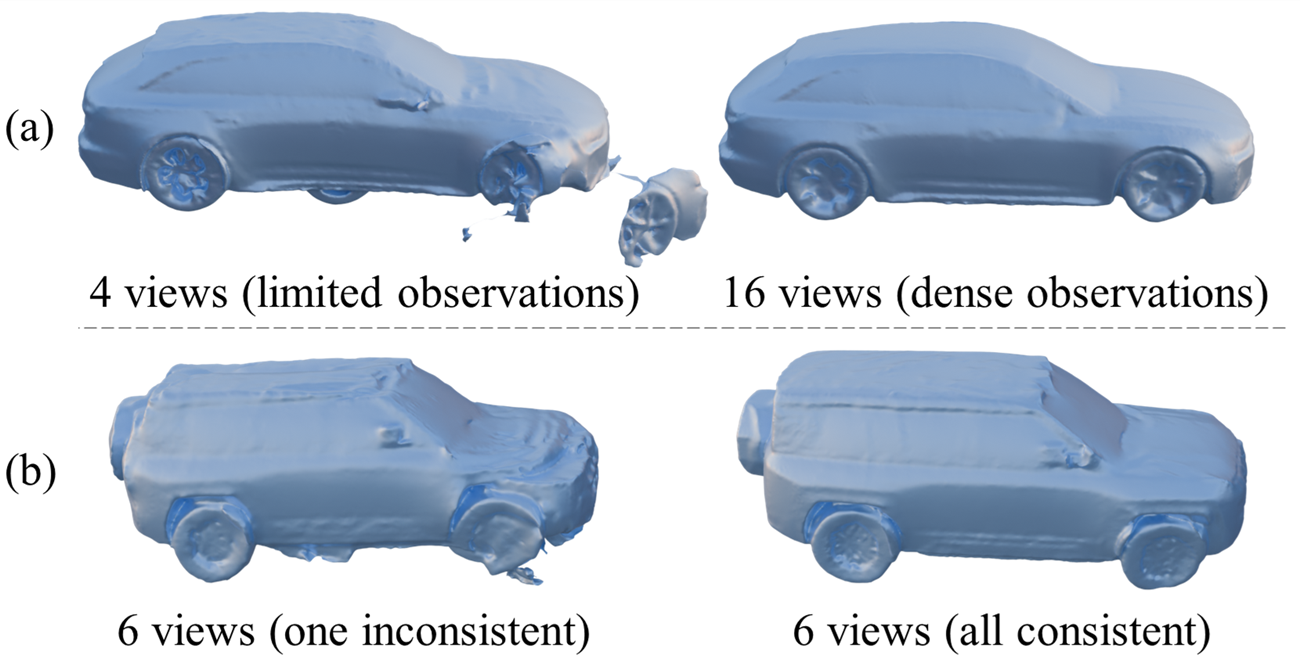
Effect of view coverage and cross-view consistency
Effect of view coverage and cross-view consistency on mesh reconstruction using the ISOMER algorithm. (a) Reconstruction results using different numbers of input views. Sparse views (left) lead to degraded reconstruction accuracy, while dense views (right) produce more reliable results. (b) Reconstruction results with the same number of views but different degrees of cross-view consistency. Even a single inconsistent view can severely degrade the reconstructed geometry.

Method

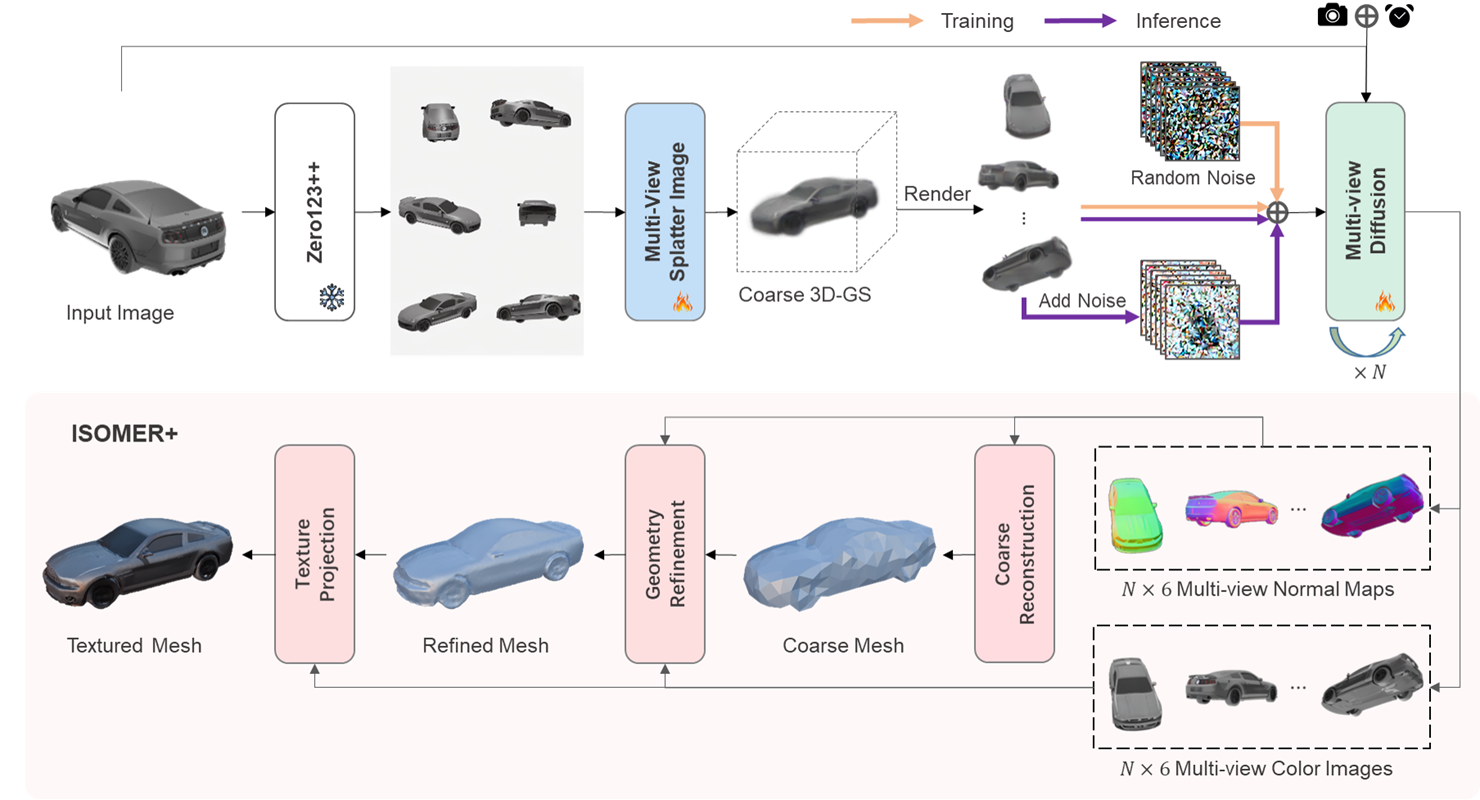
Overview of the 3DCarGen pipeline
Overview of our proposed 3DCarGen pipeline. The pipeline mainly consists of two stages: (1) Top: 3D-consistent multi-view generation through 3D synchronization. (2) Bottom: fast 3D reconstruction by ISOMER+.

Results

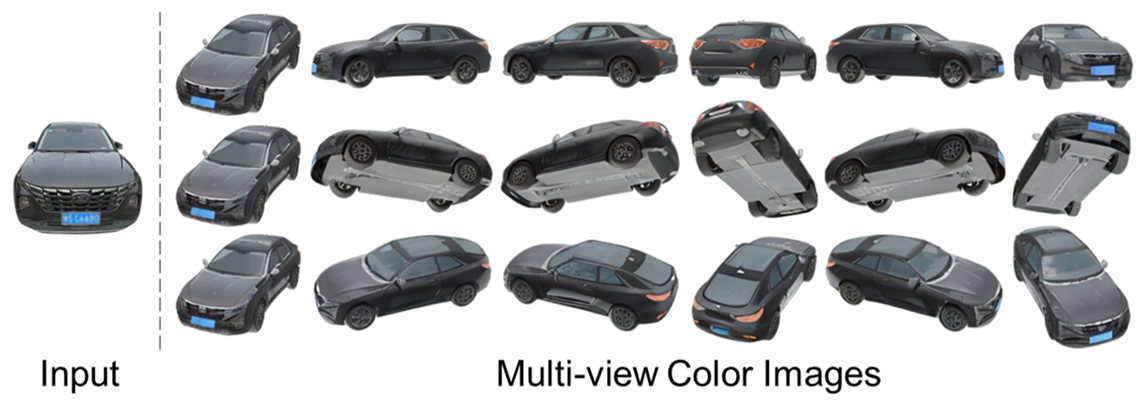
Additional multi-view RGB images generated by 3DCarGen
Example of multi-view RGB images generated by our method from a single input image.
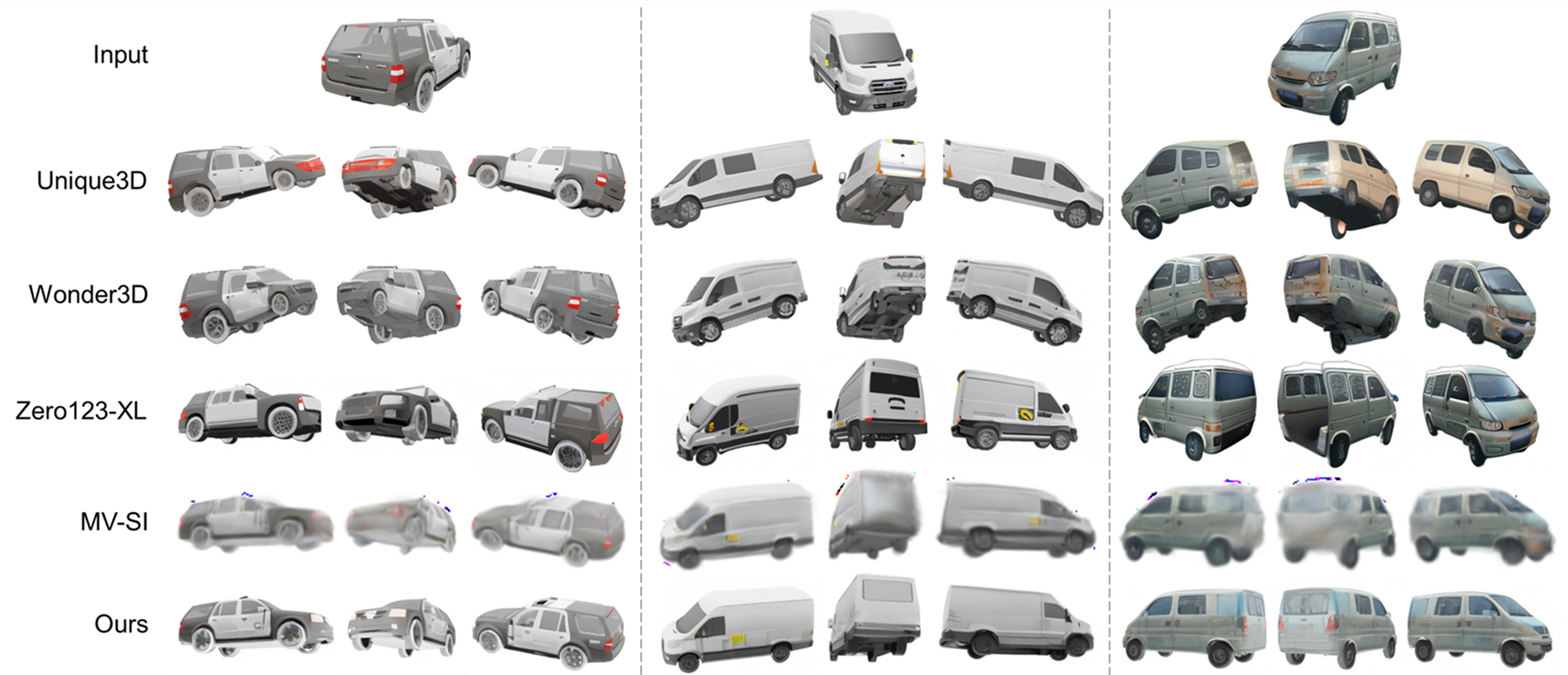
Novel view synthesis qualitative comparison
Qualitative comparison of novel view synthesis results with baseline methods. The three input images are from SRN-Cars, SketchFab-Cars, and 3DRealCar datasets (left to right).
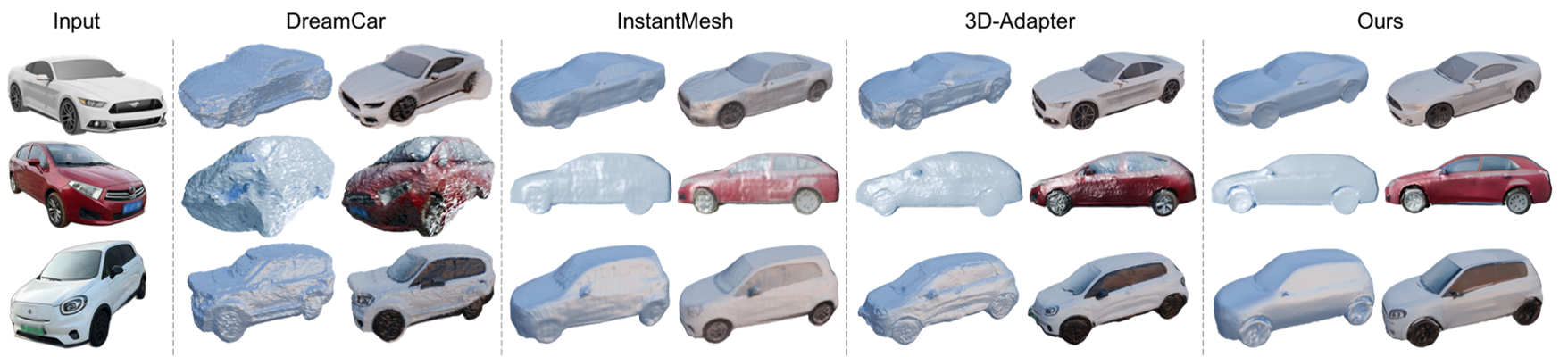
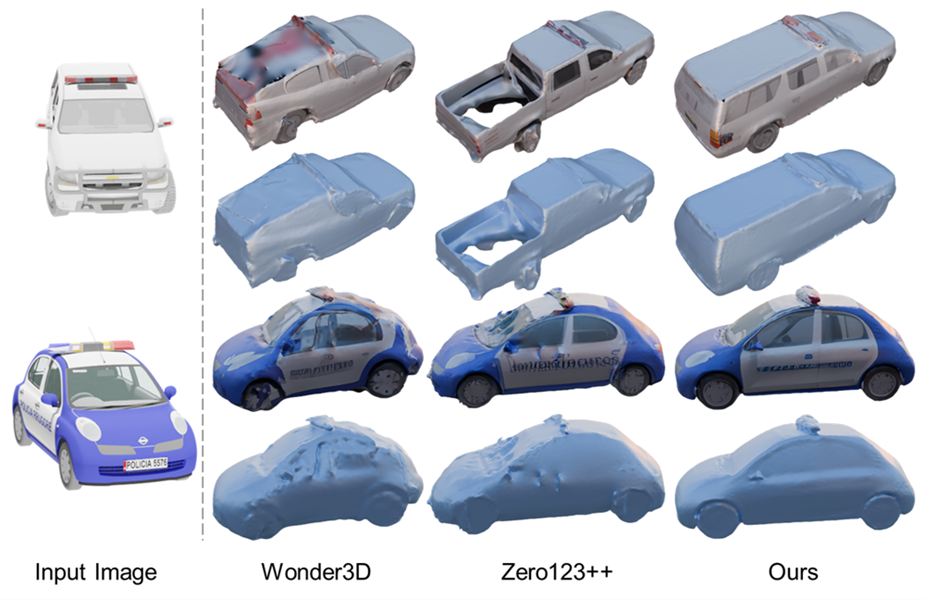
3D reconstruction qualitative comparison
Qualitative comparisons with baseline methods in 3D reconstruction.

Ablation And Analysis

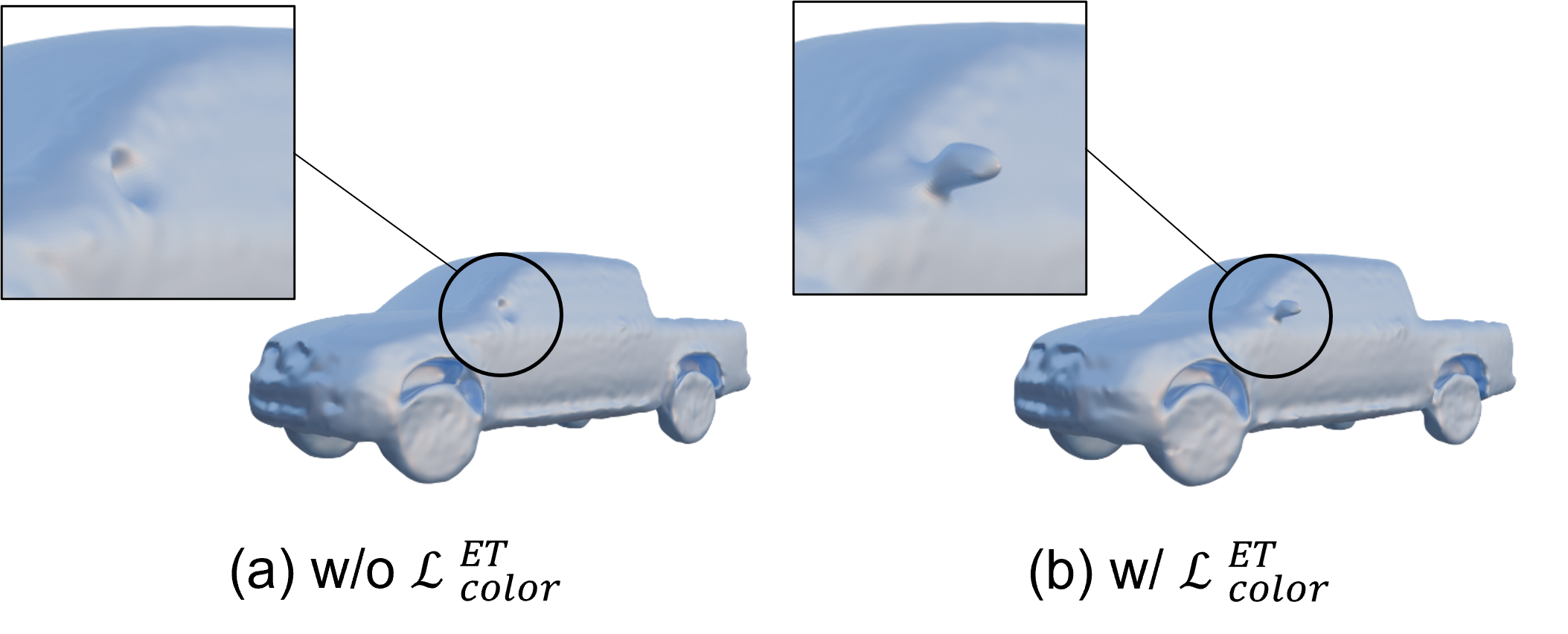
Ablation study on color loss in ISOMER+
Ablation study on $\mathcal{L}_{color}^{ET}$ in ISOMER+.
ISOMER+ reconstruction comparison from different generated views
Qualitative comparison of 3D reconstruction using ISMOER+ on multi-view images generated by different methods.

BibTeX

@misc{3DCarGen2026,
  title         = {3DCarGen: Scalable 3D Car Generation via 3D-consistent Multi-view Synthesis},
  author        = {Xiao, Hongli and Zhang, Youjian and Jin, Yaohui and Ren, Xiaoguang and Yang, Wenjing and Lan, Long},
  year          = {2026},
  eprint        = {2606.24257},
  archivePrefix = {arXiv},
  primaryClass  = {cs.CV},
  doi           = {10.48550/arXiv.2606.24257},
  url           = {https://arxiv.org/abs/2606.24257}
}